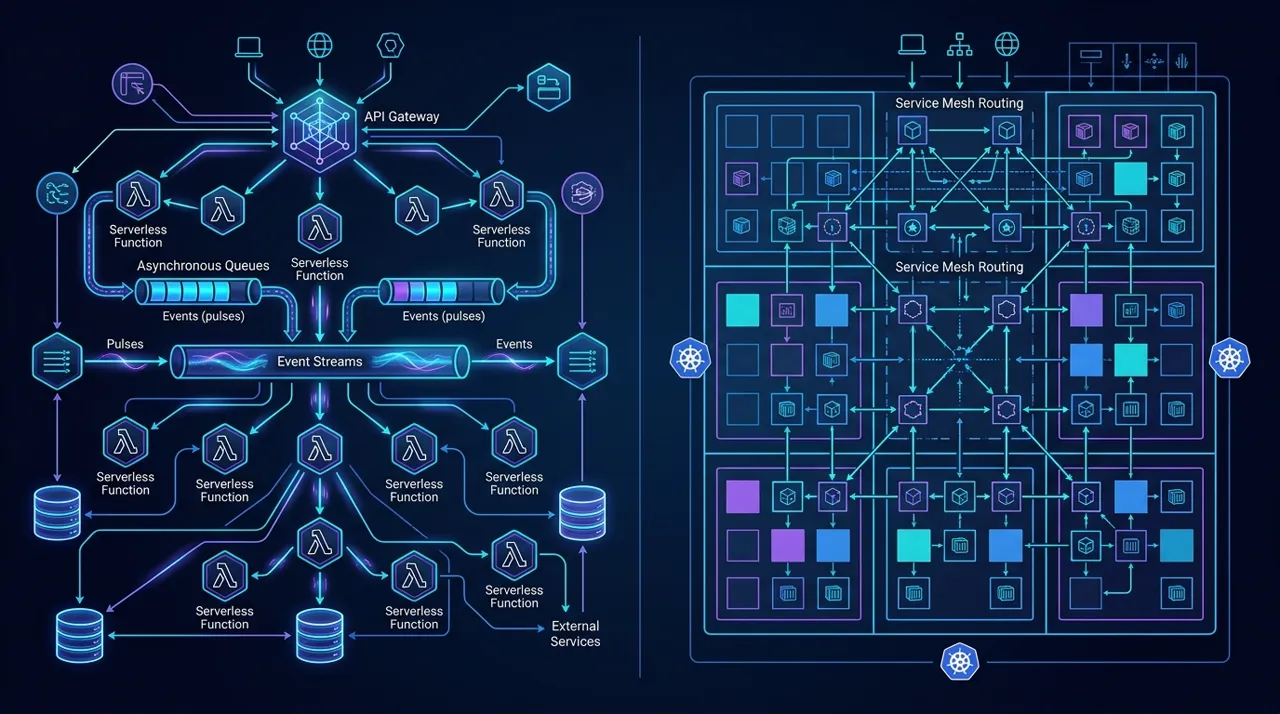
Building a prototype API that works for a few hundred requests in a controlled staging environment is trivial. Engineering an enterprise-grade REST API that withstands millions of daily requests, network partitions, misbehaving third-party clients, and aggressive retry storms without corrupting financial state or violating a 99.99% Service Level Agreement (SLA) is a completely different discipline.
In distributed enterprise environments, network calls fail unpredictably. Packets drop after a transaction has committed on the server but before the HTTP 201 response reaches the caller. Automated client retry loops then fire duplicate requests into your database. Without architectural safeguards—specifically cryptographic idempotency, multi-tiered rate limiting, and graceful circuit breaking—your system will experience double payments, distributed deadlocks, and cascading outages.
💡 Executive Summary: Enterprise REST APIs require IETF-compliant idempotency keys to guarantee safe client retries, token-bucket rate limiting to prevent noisy-neighbor exhaustion, and automated circuit breakers to protect downstream dependencies during latency spikes.
1. Architectural Foundations: The Anatomy of Resilience
Under HTTP semantics (RFC 9110), GET, PUT, and DELETE verbs are theoretically idempotent, while POST and PATCH are non-idempotent. However, in practice, network timeouts obscure whether a server processed an initial mutation. Enterprise engineering bridges this uncertainty using an explicit Idempotency-Key header (IETF draft specification).
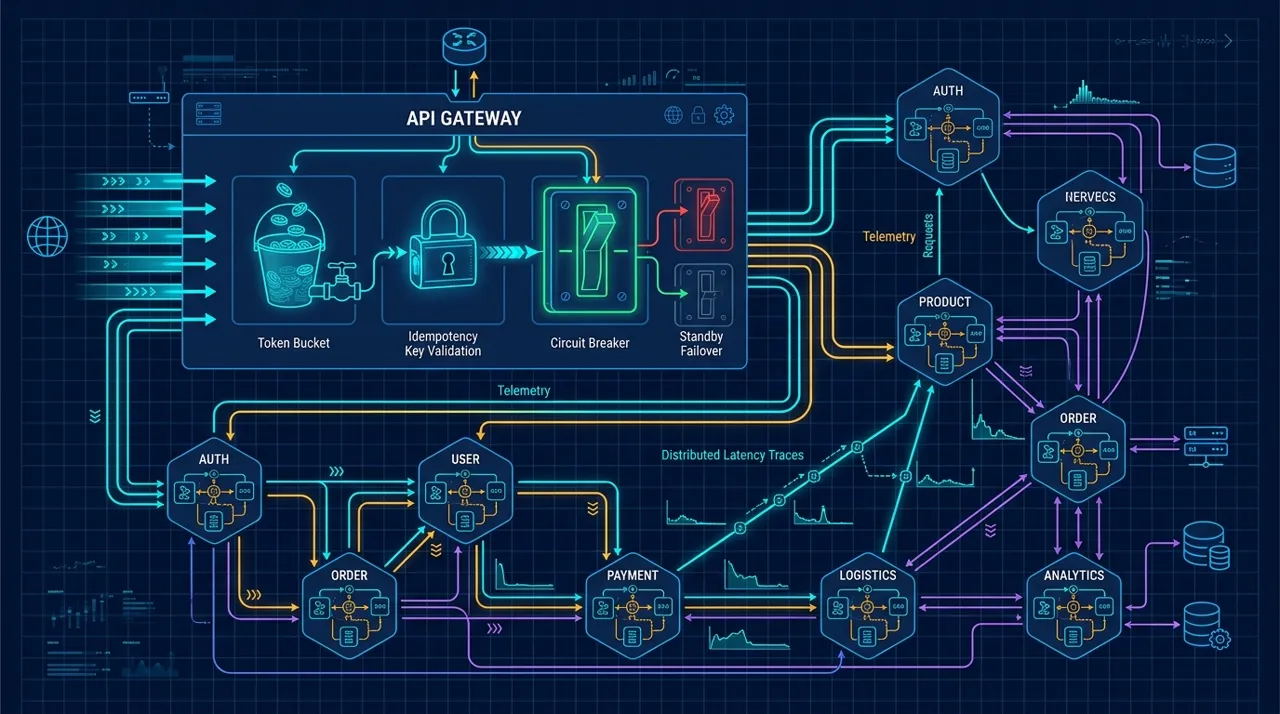
When a client initiates a mutating state change, it supplies a unique client-generated UUID in the Idempotency-Key header. The server intercepts this key, secures an atomic distributed lock, verifies whether the request has already been executed, and either processes the operation or returns the previously cached response identical to the initial execution.
| Architectural Mechanism | Operational Problem Solved | Latency Impact | Implementation Layer |
|---|---|---|---|
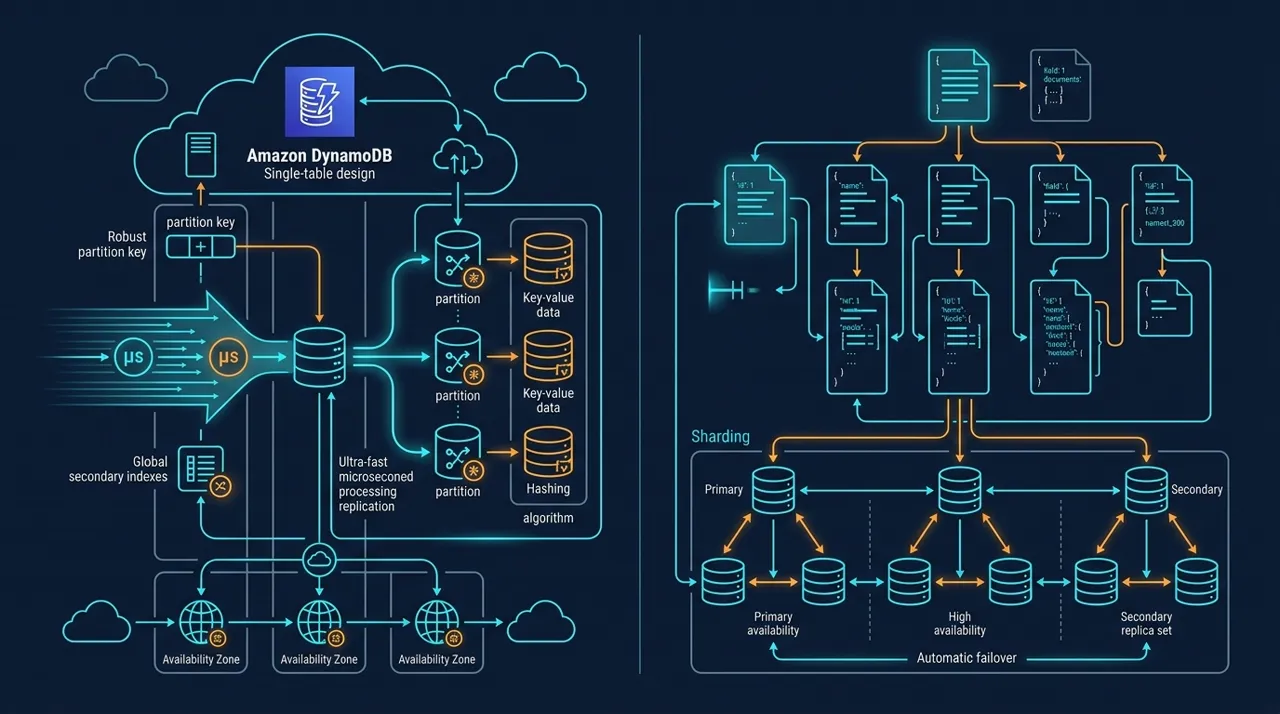
| Idempotency Locking | Prevents duplicate records, double charges, and inconsistent state during network retries. | +2ms–5ms (fast Redis or DynamoDB lock evaluation). | API Gateway middleware or Lambda request interceptor. |
| Sliding Window Rate Limiting | Shields upstream services from volumetric traffic spikes, DDoS, and rogue client loops. | +0.5ms–1.5ms (atomic Redis counter or Cloudflare/AWS WAF). | Perimeter Edge (AWS WAF / API Gateway). |
| Circuit Breakers | Prevents cascading failures when downstream microservices or third-party APIs stall. | 0ms when closed; instantaneous fallback when open. | Application HTTP client wrapper (e.g., Opossum). |
| RFC 7807 Error Schemas | Eliminates ambiguous error payloads; provides machine-readable diagnostic details. | Zero overhead. | Global application error handler. |
2. Rate Limiting Strategies: Algorithmic Comparison
Deploying a crude fixed-window counter (e.g., reset counter every 60 seconds) creates severe traffic vulnerability: clients can exhaust their entire quota in the final second of minute 1 and the first second of minute 2, delivering a 2x traffic burst that crashes internal workers.
flowchart LR
    subgraph Edge Rate Limiting
        A[Inbound Request] --> B{Token Bucket Available?}
        B -- Yes --> C[Deduct Token & Forward]
        B -- No --> D[Return HTTP 429 Too Many Requests]
    end

    subgraph Core Execution with Idempotency
        C --> E{Idempotency Key Cached?}
        E -- Completed --> F[Return Cached Response 200/201]
        E -- In Progress --> G[Return HTTP 409 Conflict]
        E -- New Key --> H[Acquire Lock -> Execute Logic -> Save Response]
    end
1. Token Bucket vs. Sliding Window Counter
- Token Bucket Algorithm: Tokens replenish at a constant rate into a virtual bucket. Bursts are permitted up to bucket capacity, but sustained throughput is strictly throttled. Ideal for APIs that must accommodate natural user bursts without sacrificing downstream protection.
- Sliding Window Log: Logs the exact timestamp of every request in a sorted set (e.g., Redis
ZSET). Highly accurate but consumes significant memory at scale. - Sliding Window Counter: A hybrid approach combining the current window and the previous window’s request count. Delivers 99% accuracy with minimal memory footprint (two integer keys per client).
3. Production Implementation: Hardened Idempotency Middleware
The following TypeScript implementation demonstrates an enterprise-grade idempotency manager for distributed serverless or containerized backends using an atomic lock pattern with Redis or DynamoDB:
import { Request, Response, NextFunction } from 'express';
import { z } from 'zod';
import { createHash } from 'crypto';

interface IdempotencyRecord {
  status: 'PENDING' | 'RESOLVED';
  statusCode?: number;
  headers?: Record<string, string>;
  responseBody?: unknown;
  payloadHash: string;
  createdAt: number;
}

// In-memory or distributed Redis client contract
interface CacheStore {
  get(key: string): Promise<string | null>;
  set(key: string, value: string, ttlSeconds: number): Promise<boolean>;
  delete(key: string): Promise<boolean>;
}

export function createIdempotencyMiddleware(store: CacheStore, ttlSeconds = 86400) {
  return async (req: Request, res: Response, next: NextFunction) => {
    // Only enforce idempotency for state-mutating HTTP methods
    if (!['POST', 'PATCH'].includes(req.method)) {
      return next();
    }

    const idempotencyKey = req.headers['idempotency-key'] as string;
    if (!idempotencyKey) {
      return res.status(400).json({
        type: 'https://api.tijiki.com/errors/missing-idempotency-key',
        title: 'Bad Request',
        status: 400,
        detail: 'The Idempotency-Key HTTP header is required for mutating requests.',
      });
    }

    // Validate key format (UUID v4)
    if (!z.string().uuid().safeParse(idempotencyKey).success) {
      return res.status(400).json({
        type: 'https://api.tijiki.com/errors/invalid-idempotency-key',
        title: 'Bad Request',
        status: 400,
        detail: 'The Idempotency-Key header must be a valid UUID v4 format.',
      });
    }

    // Hash the request body to detect payload tampering with identical keys
    const currentPayloadHash = createHash('sha256')
      .update(JSON.stringify(req.body || {}))
      .digest('hex');

    const cacheKey = `idempotency:${idempotencyKey}`;
    const existing = await store.get(cacheKey);

    if (existing) {
      const record: IdempotencyRecord = JSON.parse(existing);

      // Check if original payload matches current request
      if (record.payloadHash !== currentPayloadHash) {
        return res.status(422).json({
          type: 'https://api.tijiki.com/errors/idempotency-payload-mismatch',
          title: 'Unprocessable Entity',
          status: 422,
          detail: 'This Idempotency-Key was previously used with a different request payload.',
        });
      }

      // If previous request is still in-flight, reject concurrent race condition
      if (record.status === 'PENDING') {
        return res.status(409).json({
          type: 'https://api.tijiki.com/errors/concurrent-mutation',
          title: 'Conflict',
          status: 409,
          detail: 'A request with this Idempotency-Key is currently being processed. Please retry shortly.',
        });
      }

      // Return cached original response
      res.set(record.headers || {});
      res.set('X-Cache-Lookup', 'IDEMPOTENT-HIT');
      return res.status(record.statusCode || 200).json(record.responseBody);
    }

    // Acquire lock: Mark state as PENDING
    const pendingRecord: IdempotencyRecord = {
      status: 'PENDING',
      payloadHash: currentPayloadHash,
      createdAt: Date.now(),
    };
    await store.set(cacheKey, JSON.stringify(pendingRecord), 120); // 120s lock timeout

    // Intercept response to cache completion
    const originalJson = res.json.bind(res);
    res.json = (body: unknown) => {
      const completedRecord: IdempotencyRecord = {
        status: 'RESOLVED',
        statusCode: res.statusCode,
        headers: { 'Content-Type': 'application/json' },
        responseBody: body,
        payloadHash: currentPayloadHash,
        createdAt: Date.now(),
      };

      // Persist final resolution with full TTL (e.g., 24 hours)
      store.set(cacheKey, JSON.stringify(completedRecord), ttlSeconds).catch(console.error);
      return originalJson(body);
    };

    next();
  };
}
4. SLA Mathematics: The Cost of Four Nines (99.99%)
When enterprise contracts mandate strict Availability SLAs, understanding the mathematical error budget is essential:
Monthly Downtime Budget:
- 99.0%  ("Two Nines")  = 7 hours, 18 minutes / month
- 99.9%  ("Three Nines") = 43 minutes, 48 seconds / month
- 99.99% ("Four Nines")  = 4 minutes, 21 seconds / month
Achieving 99.99% availability means your system can endure less than 5 minutes of unplanned downtime across an entire month. In practice, this cannot be attained through manual on-call intervention; it demands automated infrastructure self-healing:
- Active Health Checks and Route 53 DNS Failover: Continuously pinging synthetic health endpoints (
/health/deep) that inspect database connectivity and upstream dependencies. - Exponential Backoff with Full Jitter: Implementing randomized retry intervals to eliminate the Thundering Herd problem, where thousands of retrying clients strike a recovering database simultaneously.
- Graceful Degradation via Circuit Breakers: When a third-party payment gateway or email provider exceeds a 5% error rate or 1,500ms latency, the circuit breaker opens, immediately returning an HTTP 503 or queuing tasks into Amazon SQS for background replay.
5. Critical Antipatterns and Architectural Traps
1. Retrying Non-Idempotent HTTP 500 Responses
When an upstream gateway encounters a database lock timeout, returning a generic HTTP 500 error that triggers aggressive client retries.
- The Failure: Repeated executions of partially committed transactions lead to data duplication, account balance drift, and database CPU saturation.
- The Remedy: Bind all client state mutations to an immutable
Idempotency-Keyand enforce atomic database transactions with rollback isolation.
2. Leaking Internal Stack Traces in Production
Allowing database constraint errors or unhandled runtime exceptions to escape directly to client responses.
- The Failure: Exposes internal table structures, framework versions, and connection strings, violating SOC2/ISO27001 compliance and handing attackers penetration vectors.
- The Remedy: Standardize on RFC 7807 (Problem Details for HTTP APIs), masking internal error details behind randomized Correlation IDs while logging full diagnostics to private cloud telemetry.
Frequently Asked Questions (FAQ)
What HTTP status code should be returned during rate limiting?
Return HTTP 429 Too Many Requests, accompanied by the standard Retry-After: <seconds> header indicating the exact time the client must wait before retrying.
How long should an Idempotency-Key be retained in cache?
Industry standard for financial and transactional APIs (such as Stripe and Adyen) is 24 hours. After 24 hours, the key expires, and a subsequent request with the same key is treated as a new transaction.
What is the difference between a retry storm and a thundering herd?
A retry storm occurs when clients aggressively retry failed requests without backoff. A thundering herd occurs when many clients wake up simultaneously (e.g., when a shared cache key expires) to recompute the same expensive resource, overwhelming the database.
Conclusion & Architecture Consultation
Designing APIs that scale to enterprise standards is an exercise in defensive engineering. By enforcing cryptographic idempotency, intelligent sliding-window rate limits, and zero-trust payload validation, you protect your business against data corruption, unexpected downtime, and customer churn.
🛠️ Refactoring an enterprise API or struggling with SLA violations and duplicate transactions?
At Tijiki, our senior engineers design high-throughput REST APIs, implement distributed idempotency architectures, and guarantee enterprise cloud resilience.
👉 Book a Free 30-Minute Cloud Architecture & FinOps Diagnostic Session