Cloud infrastructure costs have a notorious tendency to grow exponentially while engineering productivity grows linearly. According to industry surveys, technology companies routinely waste between 30% and 55% of their total monthly AWS expenditure on idle compute, misconfigured network routing, forgotten storage snapshots, and uncurated log retention policies.
When monthly AWS invoices climb from $2,000 to $15,000 or $50,000 without a proportional surge in paying users, founders and CFOs inevitably apply pressure to “cut costs.” Unfortunately, untrained engineering teams often respond by slashing critical monitoring tools, reducing high-availability redundancy, or executing desperate micro-optimizations that degrade system reliability.
True Cloud FinOps (Financial Operations) is not about deprivation or cutting corners; it is an architectural engineering discipline that aligns cloud spending directly with customer value.
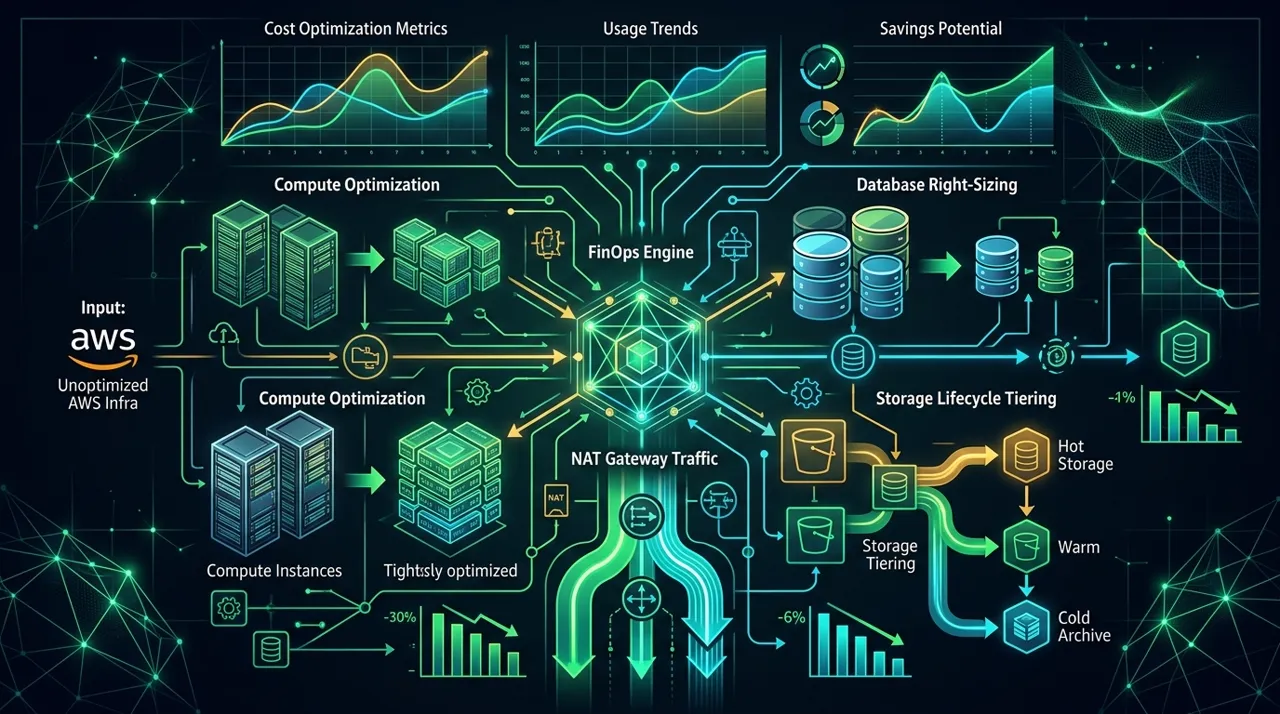
💡 Executive Summary: Slashing AWS cloud bills by 30% to 50% without downtime requires eliminating the AWS NAT Gateway bandwidth surcharge via free VPC Gateway Endpoints, enabling S3 Intelligent-Tiering, purging zombie EBS volumes, and rightsizing compute with Compute Savings Plans.
1. The Anatomy of Waste: The “Big Four” AWS Cost Leaks
In over a decade auditing cloud architectures across North America and Latin America, our senior architects consistently encounter the exact same four structural cost leaks:
flowchart TD
    subgraph The Big Four AWS Cost Leaks
        A[AWS Monthly Invoice Surge] --> B[1. The NAT Gateway Bandwidth Tax]
        A --> C[2. Zombie Storage & EBS gp2 Volumes]
        A --> D[3. CloudWatch 'Never Expire' Ingestion]
        A --> E[4. Unoptimized S3 Standard Storage]
    end

    subgraph Architectural Fixes
        B --> F[Free VPC Gateway Endpoints]
        C --> G[Automated gp2 to gp3 Migration & Orphan Cleanup]
        D --> H[Enforced 14-30 Day Retention Policies]
        E --> I[S3 Intelligent-Tiering Lifecycle Rules]
end| Cost Category | The Root Architectural Cause | Monthly Financial Waste | Recommended Engineering Remediation |
|---|---|---|---|
| VPC NAT Gateways | Routing S3 downloads, DynamoDB queries, or container pulls through NAT Gateways. | $100 to $3,000+ / mo in data processing fees ($0.045/GB). | Deploy free VPC Gateway Endpoints for S3 and DynamoDB; use VPC Interface Endpoints for ECR. |
| Zombie EBS Volumes & Snapshots | Terminating EC2 instances without deleting attached volumes; unmanaged daily snapshot chains. | $200 to $1,500+ / mo for unattached storage blocks. | Automated deletion scripts + migrating all storage from legacy gp2 to gp3 (instant 20% savings). |
| CloudWatch Logs Ingestion | Verbose console.log(event) in high-throughput Lambdas; default “Never Expire” retention. | $300 to $2,500+ / mo in storage and ingestion charges ($0.50/GB). | Enforce 14-to-30 day log retention policies; use structured JSON logging with debug log level switches. |
| Static S3 Storage | Retaining terabytes of archival customer assets in default S3 Standard pricing tier. | $500 to $5,000+ / mo for data that hasn’t been accessed in 180 days. | Implement S3 Intelligent-Tiering with automated Glacier Instant Retrieval transitions. |
2. Deep Dive: Eliminating the AWS NAT Gateway Tax
The single most common financial mistake in AWS networking is placing workloads (ECS tasks, Lambda functions, EKS nodes) inside private subnets and routing all outbound traffic through an AWS NAT Gateway.
The Hidden Math of NAT Gateway Pricing
- Hourly Base Charge: $0.045 / hour per NAT Gateway × 730 hours = $32.85 USD / month per gateway (typically $65.70/mo for a multi-AZ pair).
- Data Processing Surcharge: $0.045 per Gigabyte processed.
If your backend downloads 20 TB of model weights, container images, or backup files from Amazon S3 through a NAT Gateway:
20,000 GB × $0.045 / GB = $900.00 USD / month
Total NAT Gateway Invoice: ~$965.70 USD / month
The Architectural Fix: Free VPC Gateway Endpoints
Amazon S3 and Amazon DynamoDB support VPC Gateway Endpoints, which route traffic internally across the AWS private network completely bypassing the NAT Gateway:
- Setup Cost: $0.00 USD.
- Data Processing Cost: $0.00 USD / GB.
- Direct Savings: $900.00 USD/month recovered with zero lines of application code modified.
3. Infrastructure as Code: Automated FinOps Governance Blueprint
FinOps governance must be enforced through immutable IaC to guarantee that newly provisioned resources never bypass cost optimization rules. Below is a production-grade AWS CDK (TypeScript) construct enforcing log retention, storage tiering, and real-time budget anomaly alerts:
import * as cdk from 'aws-cdk-lib';
import { Construct } from 'constructs';
import * as s3 from 'aws-cdk-lib/aws-s3';
import * as logs from 'aws-cdk-lib/aws-logs';
import * as budgets from 'aws-cdk-lib/aws-budgets';
import * as sns from 'aws-cdk-lib/aws-sns';

export class FinOpsGovernanceStack extends cdk.Stack {
  constructor(scope: Construct, id: string, props?: cdk.StackProps) {
    super(scope, id, props);

    // 1. S3 Bucket with Automated Intelligent-Tiering & Lifecycle Transition
    const optimizedStorageBucket = new s3.Bucket(this, 'FinOpsOptimizedBucket', {
      bucketName: `tijiki-cost-optimized-assets-${this.account}`,
      encryption: s3.BucketEncryption.S3_MANAGED,
      blockPublicAccess: s3.BlockPublicAccess.BLOCK_ALL,
      lifecycleRules: [
        {
          id: 'AutoIntelligentTieringRule',
          enabled: true,
          // Move objects to Intelligent-Tiering immediately to prevent cold standard charges
          transitions: [
            {
              storageClass: s3.StorageClass.INTELLIGENT_TIERING,
              transitionAfter: cdk.Duration.days(0),
            },
            {
              storageClass: s3.StorageClass.GLACIER_INSTANT_RETRIEVAL,
              transitionAfter: cdk.Duration.days(90),
            },
          ],
          // Clean up incomplete multipart uploads after 7 days
          abortIncompleteMultipartUploadAfter: cdk.Duration.days(7),
        },
      ],
    });

    // 2. CloudWatch Log Group with Mandatory 30-Day Expiration (No 'Never Expire')
    const productionLogGroup = new logs.LogGroup(this, 'StrictRetentionLogGroup', {
      logGroupName: '/aws/application/tijiki-api-production',
      retention: logs.RetentionDays.ONE_MONTH, // Automatically purges old logs
      removalPolicy: cdk.RemovalPolicy.DESTROY,
    });

    // 3. SNS Topic for Budget Alert Notifications
    const alertTopic = new sns.Topic(this, 'FinOpsBudgetAlertTopic', {
      displayName: 'FinOps Budget Anomaly Alerts',
    });

    // 4. Automated AWS Budget Guardrail
    new budgets.CfnBudget(this, 'MonthlyCloudBudget', {
      budget: {
        budgetName: 'MonthlyCloudSpendGuardrail',
        budgetType: 'COST',
        timeUnit: 'MONTHLY',
        budgetLimit: {
          amount: 2500, // Monthly limit in USD
          unit: 'USD',
        },
      },
      notificationsWithSubscribers: [
        {
          notification: {
            notificationType: 'FORECASTED',
            comparisonOperator: 'GREATER_THAN',
            threshold: 90, // Alert when forecasted spend exceeds 90% of budget
            thresholdType: 'PERCENTAGE',
          },
          subscribers: [
            {
              subscriptionType: 'SNS',
              address: alertTopic.topicArn,
            },
          ],
        },
      ],
    });
  }
}
4. Compute Optimization: Savings Plans vs. Reserved Instances vs. Spot
Once architectural waste has been eliminated, compute optimization yields the next 20% to 35% in direct savings:
Compute Commitment Models Compared:
1. On-Demand Pricing: Maximum flexibility, zero commitment, 100% full retail cost.
2. Compute Savings Plans: Up to 66% discount in exchange for a 1-year or 3-year commitment of $/hr spend. Applies automatically across EC2, Fargate, and Lambda regardless of instance family, OS, or AWS region.
3. EC2 Instance Savings Plans: Up to 72% discount, but restricts commitment to a specific instance family within a single region.
4. Spot Instances: Up to 90% discount on spare AWS compute capacity. Ideal for asynchronous queue workers (SQS consumers) and batch processing that can tolerate graceful termination.
The FinOps Recommendation: Startups and mid-market organizations should never purchase rigid Reserved Instances. Standardize on 1-Year No-Upfront Compute Savings Plans, covering 70% of your baseline steady-state compute. This secures an immediate ~28% to 35% discount while retaining complete architectural agility to change instance types or migrate to Serverless.
5. Critical Antipatterns and Architectural Traps
1. Migrating to Legacy EBS gp2 Instead of gp3
Provisioning default gp2 storage volumes when launching EC2 instances or RDS databases.
- The Waste:
gp2ties I/O performance directly to disk size, forcing teams to over-provision gigabytes just to obtain necessary IOPS. - The Remedy: Migrate to EBS gp3. It delivers 3,000 baseline IOPS and 125 MB/s throughput independently of volume size at a flat 20% discount compared to
gp2.
2. Disabling Monitoring and Observability to Save Money
Deleting Datadog, reducing CloudWatch metrics, or turning off distributed tracing in an attempt to trim expenses.
- The Failure: You save $200 on logging tools only to experience a 4-hour production outage because engineers lack the telemetry required to diagnose a critical database deadlock.
- The Remedy: Optimize telemetry volume by dropping high-entropy debug logs in production, sampling traces (e.g., sample 5% of healthy 200 OKs, 100% of 5xx errors), and leveraging native CloudWatch Metric Filters.
Frequently Asked Questions (FAQ)
How quickly can a company see results from an AWS FinOps sprint?
Infrastructure waste remediation (VPC endpoints, log retention, gp3 migrations, and orphan snapshot deletion) reflects on your AWS Cost Explorer dashboard within 24 to 48 hours, immediately reducing your month-end projection.
Will applying FinOps optimizations require application downtime?
No. High-impact FinOps optimizations—such as provisioning VPC Gateway Endpoints, updating S3 lifecycle rules, migrating EBS volume types, and purchasing Compute Savings Plans—are executed entirely on the cloud control plane with zero application downtime.
What tools are recommended for continuous AWS FinOps tracking?
Combine native AWS Cost Explorer and AWS Budgets with automated anomaly detection alerts. For multi-account enterprise organizations, open-source tools like Infracost integrate into CI/CD pull requests to forecast infrastructure cost changes before code merges to main.
Conclusion & FinOps Diagnostic
Cloud cost optimization is not a one-time crisis response—it is an ongoing architectural practice. By eliminating architectural tax, rightsizing storage tiers, and locking in strategic compute commitments, your engineering team can free up tens of thousands of dollars to reinvest in high-leverage product development.
🛠️ Is your monthly AWS bill spiraling out of control?
At Tijiki, our certified senior architects perform thorough AWS FinOps Audits, identifying architectural waste, eliminating network surcharges, and cutting cloud bills by 30% to 50% with zero downtime.
👉 Book a Free 30-Minute Cloud Architecture & FinOps Diagnostic Session